Scour monitoring is the process of measuring how flowing water erodes the bed around underwater structures, so that damage can be found before it threatens the structure.
This guide draws on a peer-reviewed study by the University of Twente using the Impact Subsea ISS360 Imaging Sonar.
What is scour monitoring?
Scour monitoring means tracking how water flow removes sediment and protective material from the bed around a structure such as a lock, quay wall or bridge pier. Because scour develops over time, repeated or continuous measurement lets asset owners see whether the bed protection is still doing its job and plan maintenance before the structure’s foundations are at risk.
Why does scour happen at navigation locks?
At navigation locks, scour is driven by river flow and by currents from ships: propeller wash, bow thrusters, and the water released when lock chambers are filled and emptied. Many locks were built for smaller vessels than the ones using them today, so the bed is under more strain than it was designed for.
There are three main risks:
- Scour holes: that undermine the bed protection and eventually, the structure itself.
- Rolling stones: rocks displaced from the bed protection that end up in the lock. Obstructions like these can stop gates from closing and damage components such as de-icing pipes.
- Shallow under-keel clearance: Rijkswaterstaat guidance recommends a water depth of 1.4 times a ship’s draft. For the 4 m-draft vessels the lock’s newest chamber was built for, that means 5.6 m, and the researchers found the Prinses Beatrix Lock doesn’t meet it. Loaded and unloaded ships can also differ in draft by up to 2 m, so knowing how deep each vessel actually sits matters.
What are the stages of scour?
Scour research typically describes three stages in how a local scour hole develops:
| Stage | What happens |
|---|---|
| Initial erosive stage | Flow starts removing material from the bed |
| Development stage | The scour hole deepens and grows |
| Equilibrium depth | The hole stabilises at its maximum depth for the flow conditions |
Because scour depends on time, the University of Twente researchers describe continuous monitoring of scour-prone areas as crucial.
Why is visual inspection difficult?
Diver inspections and bathymetric surveys give valuable detail but they are costly, only capture moments in time and are limited by turbidity: in murky inland water, a diver or camera may barely see the bed. Changes caused by a single ship passage can happen and go unnoticed between inspections.
How does a 2D imaging sonar detect bed changes?
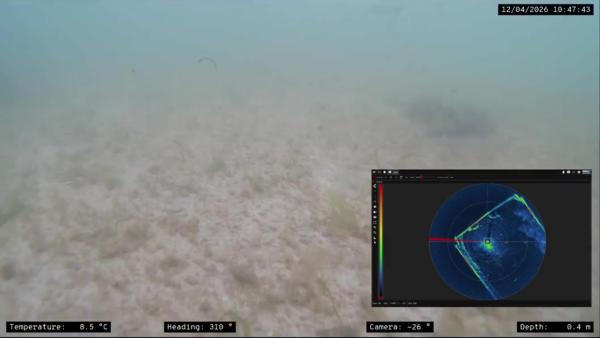
An imaging sonar builds a picture of the bed from sound rather than light, so turbidity doesn’t stop it. When it’s fixed in place, it scans the same area over and over. At the Prinses Beatrix Lock, an image was saved every minute and divided into small regions of interest.
Each region was compared with the same region in later images. Rock pieces show up as bright spots, and their stable pattern acts as a “fingerprint” of the bed protection. When the pattern changes, material has moved.
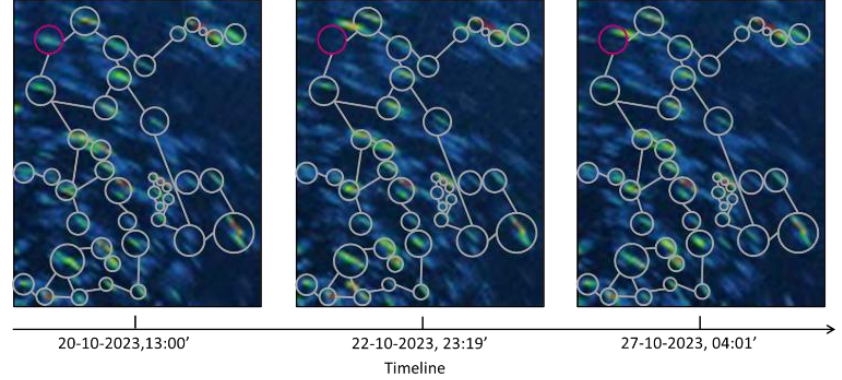
Can sonar detect loose stones in a lock?
Yes. The sonar tracked stones on the lock chamber’s concrete floor, and one persistent bright spot was confirmed by an underwater drone to be a substantial rock. Spots that appeared briefly were put down to fish or light objects, while spots that stayed for more than an hour pointed to heavier objects. Stones could be detected at a range of 30 m.
Can sonar measure a ship’s draft?
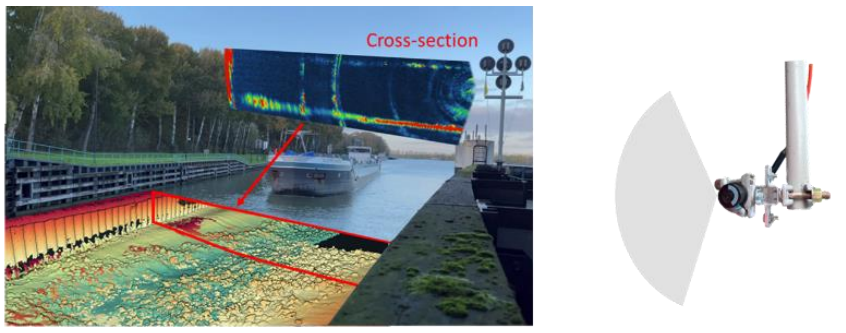
It can indicate it. With the ISS360 tilted 90°, a passing hull blocks the sonar’s sound and shows up as a strong reflection. How far that reflection extends towards the bed indicates the ship’s draft and under-keel clearance. In this setup the sonar sat at about 3.5 m depth, so drafts beyond that couldn’t be resolved. The study didn’t report accuracy figures.
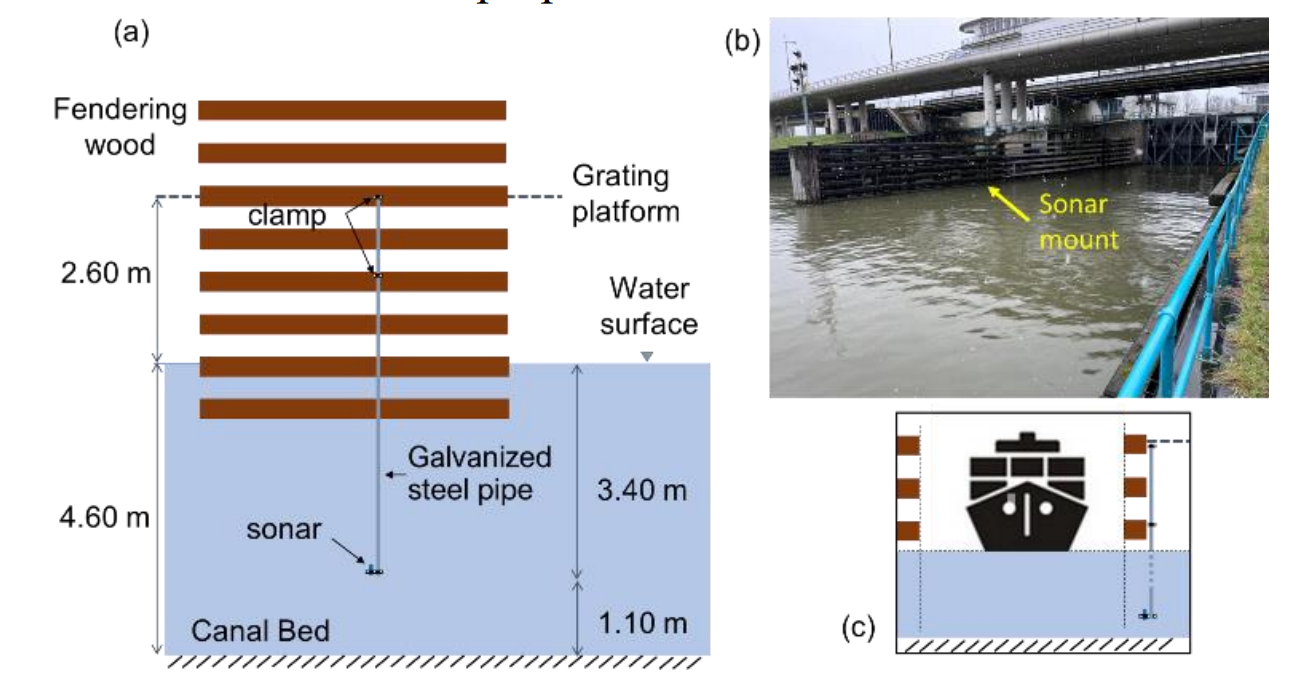
Case study: the Prinses Beatrix Lock, Netherlands
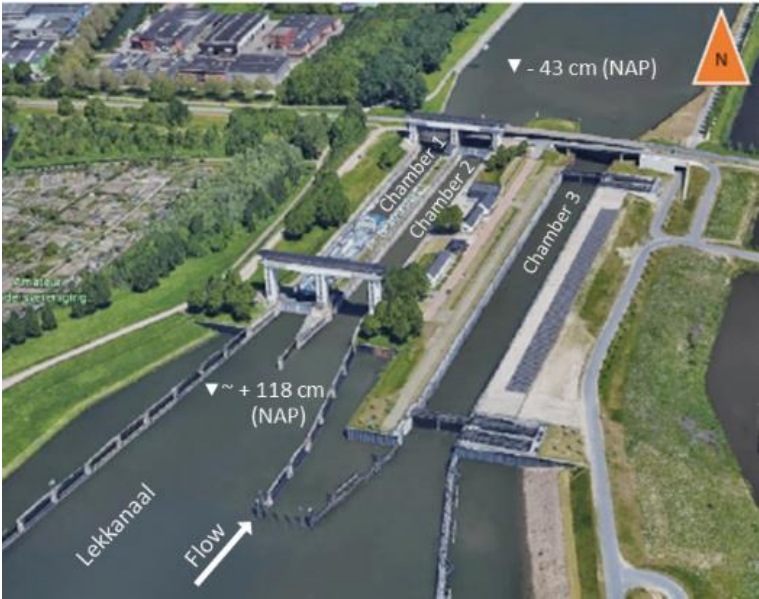
The Prinses Beatrix Lock on the Lekkanaal, which links the Lek River and the Amsterdam-Rhine Canal, is the largest monumental inland navigation complex in the Netherlands. Around 50,000 vessels pass through it each year. Diver reports and point cloud data had already shown degradation of the bed protection, along with a scour hole near one chamber.
Researchers Mohsen Bastani and Rolands Kromanis of the SHM4SI research team at University of Twente, scored 12 commercial 2D sonars and selected the ISS360. They mounted it on a 6 m steel pipe clamped to the lock’s fendering timbers, behind the fender wood so it stayed clear of passing ships. Their paper, “2D sonar techniques for monitoring the canal bed morphology of entrances to navigation locks”, won best paper at SHMII-13.
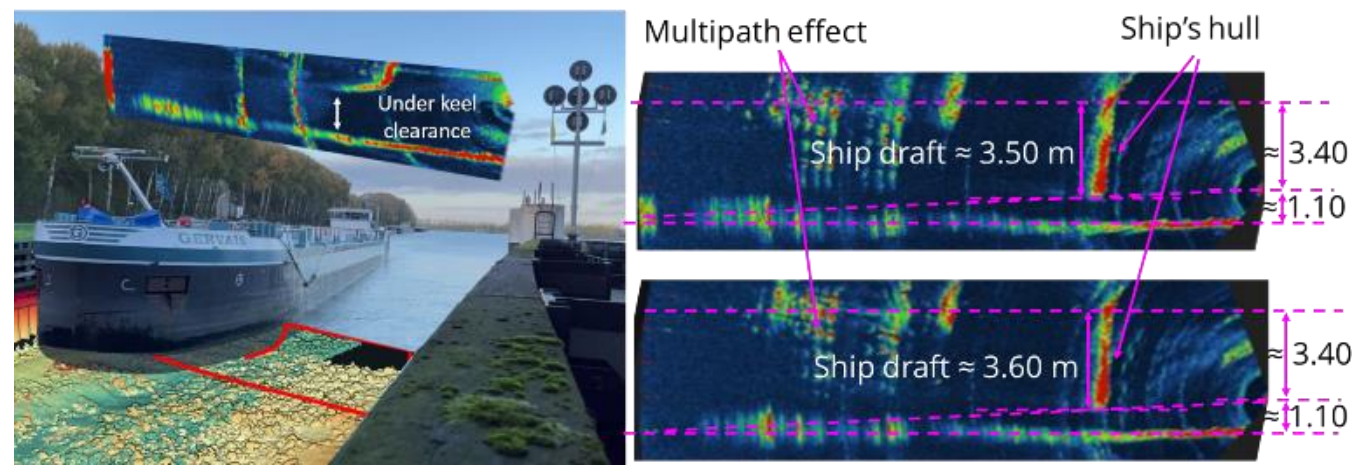
hull in the sonar image, and estimated draft of two large ships at the same distance from the sonar (right).
Key findings:
- Bed changes caught as they happened. Over 7 days of scanning, the system detected a 0.5 m² stone shifting within one minute of a ship passage. That met the project’s requirement to capture changes of 0.5 m² or more within 3 minutes.
- Weak areas identified. Some areas kept a stable pattern for days, then rearranged after a ship passed. That points to loose stones or sand-filled voids in the protection layer.
- Ship passages linked to degradation. Matching sonar images to specific passages gave evidence of which ships were displacing stones. In 50 hours of draft measurement, 22 passages had drafts over 3 m.
Limitations and next steps: a 2D sonar can’t capture vertical faces (which is why it was tilted for draft measurement), its field of view makes it hard to trace where stones came from, and the dataset was small. The researchers recommend at least six months of continuous data, extending monitoring to the other chambers and automated detection that links bed changes to individual ship passages.
“Imaging sonar is usually thought of as a vehicle sensor. This study shows it can also be a permanent monitoring sensor, fixed in place and watching a critical asset in conditions where nobody could see.”
Ben Grant, Managing Director, Impact Subsea.
Download the case study | Read the paper | Learn about the ISS360 Imaging Sonar | Read the news announcement
Why the ISS360 suits fixed monitoring
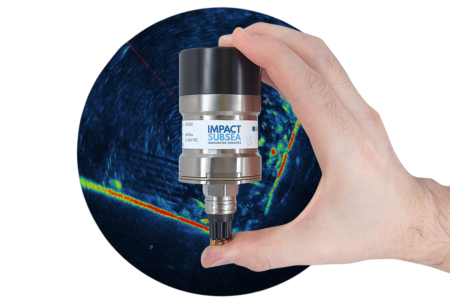
The ISS360 is a compact scanning imaging sonar, just 47 mm in diameter, with a 360° field of view, a range of up to 90 m and a 6,000 m depth rating. In the study it ran on 24 V DC, drawing 150 mA while scanning. Its small size made it straightforward to mount on existing lock structures.
Frequently asked questions
What is scour monitoring?
Scour monitoring is measuring how flowing water erodes the bed around underwater structures such as locks, quay walls and bridge piers, so damage can be found and repaired before it threatens the structure.
Can imaging sonar work in muddy or turbid water?
Yes. Imaging sonar uses sound rather than light, so it can image the bed in water where divers and cameras can’t see.
Can sonar replace divers for scour inspection?
Sonar complements diving rather than replacing it. A fixed sonar provides continuous data between inspections and catches changes as they happen, which helps target when and where divers are needed.
Which Impact Subsea sonar was used in the study?
The ISS360 Imaging Sonar, selected from 12 commercial 2D sonars and mounted at the Prinses Beatrix Lock in the Netherlands.
Want to talk about scour monitoring for your site? Contact our team or email info@impactsubsea.co.uk.