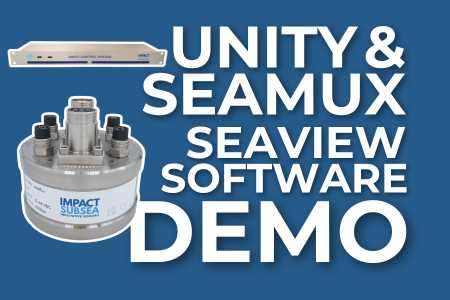
Together, these two high-performance solutions, subsea multiplexer & topside control system are designed to streamline sensor integration, simplify telemetry and enhance data management for demanding subsea vehicle operations.
seaMux – Subsea Multiplexer
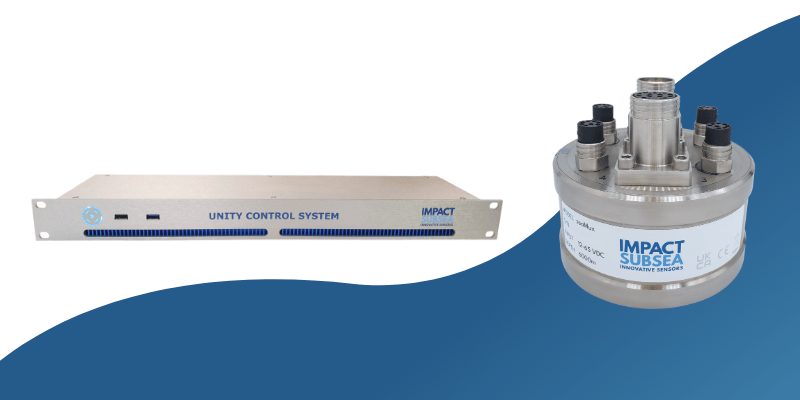
seaMux is a highly compact, titanium-housed subsea multiplexer engineered to support a wide range of underwater instrumentation, including sonars, profilers, altimeters, depth and Attitude and Heading Reference Systems (AHRS).
Rated for depths up to 6,000 meters, it is equally suited for shallow and deep-water applications.
The system features four versatile communication ports, each supporting Ethernet, RS232 or RS485 protocols.
To ensure scalability, users can daisy-chain multiple seaMux units together or leverage RS485 multidrop and y-splice cables to host multiple serial sensors on a single port.
Each port is paired with a software-controllable 24VDC power output featuring real-time power monitoring.
Data transmission to the surface is incredibly flexible, utilising either standard Ethernet or high-bandwidth VDSL telemetry over a single screened twisted pair.
Unity – Topside Control System
To complement the subsea hardware, Unity Control System serves as the topside control interface for the underwater sensor suite.
Housed in a 1U high, 19-inch rack-mountable form, Unity runs Impact Subsea’s powerful seaView software.
seaView allows operators to easily view, log and manage sensor data while facilitating data flow in and out of seaMux and Unity.
Mirroring the versatility of the subsea seaMux, the Unity system features four communication ports (each capable of providing RS232, RS485 or Ethernet) with software-controllable 24VDC power to manage local, topside connections.
A remarkable capability of the combined system is port bridging, which forms a seamless link between a port on seaMux and a port on Unity topside interface, allowing for the transparent throughput of any third-party data.
This allows Unity and seaMux to be used with a combination of Impact Subsea sensors and third party sensors. Or purely with third party sensors and instrumentation.
“seaMux is a compact and highly flexible subsea multiplexer,” stated Ben Grant, Managing Director of Impact Subsea. “A complete sensor suite can be connected to seaMux and controlled from seaView running on Unity.
In addition to supporting Impact Subsea sensors, the system also allows connection of third party sensors and instrumentation.
Those looking for a compact and flexible subsea multiplexer and topside control system for use on underwater vehicles now have a new highly capable solution available to them”.
Impact Subsea Launches Advanced Subsea Multiplexer and Topside Control System – Film Transcript
Hi, I’m Ben Grant, Managing Director of Impact Subsea.
Today, we’re excited to announce the launch of two new products.
Firstly, we’re launching seaMux, a highly compact subsea multiplexer. Depth rated to 6,000m and available in a fully titanium housing.
seaMux provides the capability to network together multiple Impact Subsea sensors or third party sensors.
seaMux itself provides you with four communication ports. Each port can be individually set up to either be Ethernet, RS232 or RS485 serial communications. This allows Ethernet sensors to be connected along with serial sensors.
Once all the sensors are connected, there’s a connector for transmission to the surface and this can be over Ethernet communications or VDSL.
VDSL is quite a unique feature in that it allows us to put together a whole suite of sensors and transmit all the data over a simple screened twisted pair.
This allows a high bandwidth capability to be added to ROVs that don’t have Ethernet, don’t have fiber. An example setup is to have seaMux with two Impact Subsea profilers, an imaging sonar, a depth sensor, an altimeter, and a heading sensor all running into the one unit here and transmitted back to the surface.
seaMux itself is primarily intended for use with Impact Subsea sensors, but it can also be used with third party sensors. Any sensor which has Ethernet telemetry or RS232 or RS485 serial telemetry can have its data put through seaMux, transmitted to the surface and broken out topside for interfacing to a third party system.
In addition to seaMux, we’re also launching Unity which is our topside control system. Unity is a full computer and communications interface in a 1U high 19-inch rack-mountable form factor.
The front is a very clean design. You have a power button, a couple of USB ports to allow getting data in and out the system, and a couple of inlets for air cooling of Unity.
On the back of Unity, you have a number of ports here. These four ports can all be serial or Ethernet ports, and they can be for direct connection to a sensor, or they can be for outputting data that’s input into the seaMux.
Then you’ve got your connection from the topside to subsea, which can either be Ethernet or VDSL.
Then you have a number of ports, standard computer ports and a power input for Unity.
So Unity and seaMux work hand in hand and provide the capability to have a full sensor suite of Impact Subsea sensors plus additional third party sensors.
Unity and seaMux can also be used purely with third party sensors if required.
Full product specifications can be found on the Unity and seaMux webpages.