Q: What was the primary motivation behind developing the seaMux and Unity systems?
Users of our sensors are increasingly integrating more complex sensor suites into their ROVs.
We wanted to provide a solution that simplifies the cabling infrastructure while giving users more intelligent control over their technology.
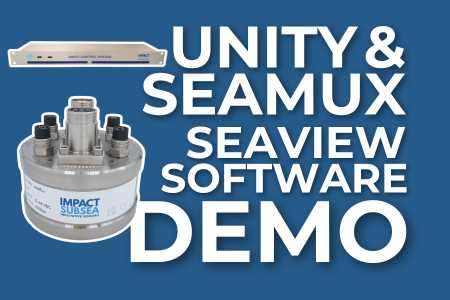
By pairing seaMux and Unity, we offer a seamless, “plug-and-play” experience that handles everything from data logging to sensor power management.
Q: How does the seaMux differ from other subsea multiplexers on the market?
seaMux is built for extreme reliability in a compact, titanium package. Its 6,000-meter depth rating makes it incredibly versatile and its ability to daisy-chain multiple multiplexers together allows it to scale with the user’s sensor requirements. It isn’t just about multiplexing signals; it’s about creating a robust, scalable architecture that can handle both our own sensors and third-party devices with ease.
One of the other main benefits of the system is the ability to use Ethernet or VDSL as the subsea to surface telemetry link. VDSL allows a high bandwidth connection over a single screened twisted pair. This facilitates the use of latest generation sensing technology on ROVs which do not have Ethernet telemetry available.
Q: Can you explain the importance of the software-controllable power ports in the Unity system?
For ROVs, this allows sensors to be powered down when not required though the seaView software – ideal if working on a vehicle with a particularly power hungry array of equipment on it which needs to be carefully managed.
For AUVs, this is an ideal feature for mission endurance. Often, sensors don’t need to be running at all times. Being able to remotely enable or disable power to specific ports via our seaView software or Software Development Kit allows users to manage their power budget actively, effectively extending the mission life of the vehicle.
Q: Are these systems compatible with third-party, non-Impact Subsea equipment?
Absolutely. We designed Unity and seaMux with interoperability in mind. Both the seaMux and Unity support standard RS232, RS485 and Ethernet protocols. Whether you are using Impact Subsea sensors or incorporating third-party serial sensors, the system acts as a transparent, high-performance conduit for your data from ROV to surface.
Ports on the seaMux can be bridged to ports on Unity or to virtual Serial Over Lan (SOL) ports. This allows data to be transparently passed through the system from a third party sensor subsea to a third party system topside.
Q: What is the single biggest benefit an ROV survey team will see from using this integration?
It’s the reduction in complexity. Being able to pull together a complete sensor suite on the ROV and scale the system as you need is a powerful capability.
The physical scalability exists through being able to physically extend the ROV system by daisy chaining seaMux multiplexers.
seaView running on Unity at the topside enables simple setup and operation of any system – including those with many sensors.