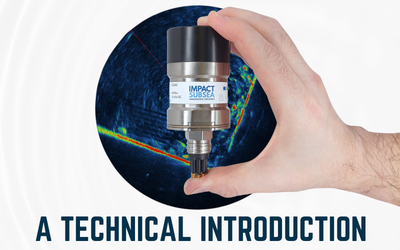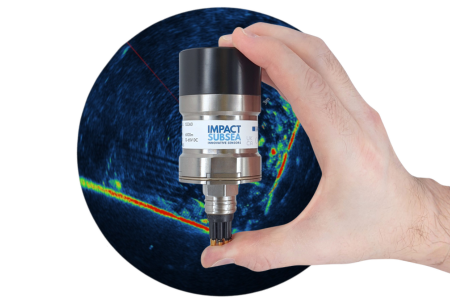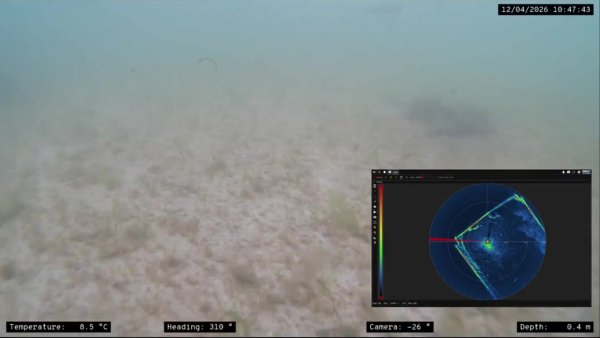
We didn’t just want to make it smaller; we wanted to make it better. Alana and Andrew discuss how the ISS360 series visibility is breaking boundaries by incorporating features usually reserved for much larger systems:
- IS³ Impact Subsea Signalling Scheme: Using advanced phase modulation and coding techniques to provide exceptional signal integrity, timing accuracy and range resolution.
- Longevity: The unique use of inductive coupling means no slip rings to wear out, housed in a robust titanium shell and depth-rated to 6,000m.
- All-in-One Navigation: The option for integrated Pitch & Roll sensing capability from a single, tiny device.
- High-Speed Data: Utilising Ethernet comms to achieve update rates up to 6 times faster than conventional serial-only systems.
Whether you’re navigating a micro-ROV or conducting a large-scale AUV survey, this episode covers how the ISS360 provides a “step change” in underwater visibility.
See our case studies on how the ISS360 is being used in real-world projects.
Transcript – Is your underwater visibility holding you back?
Welcome back to the deep dive. So today we’re looking at a piece of engineering that is, I mean, it’s honestly punching way above its weight class. Way above. We’ve got the technical docs for the ISS360 and ISS360HD Imaging Sonars from Impact Subsea. And when I say weight class I mean that literally.
This thing is what 0.37kg. It’s tiny. I mean it’s just unbelievably small. And you know usually in underwater acoustics tiny often means toy right. A glorified fish finder. Exactly. low range, low resolution. But looking at the specs here, Impact Subsea has somehow crammed world class imaging into a body the size of a soda can, which is the mission for this deep dive, right? How did they pull that off? And it seems like the secret sauce really starts with the signal itself.
If you look at older mechanical sonars, they all rely on that single frequency pulse and that creates this huge bottleneck with something called range resolution. That is the big hurdle. Yeah. Range resolution is basically just the ability to tell that two objects are actually two distinct objects and not just one big blurry blob. Exactly. And in a standard system, that resolution is tied strictly to the pulse length.
So a typical setup might only distinguish objects if they’re what about 150mm apart, which is roughly 6in. That’s fine if you’re looking for a shipwreck, I guess, but it’s a total disaster if you’re trying to, you know, manipulate a valve with an ROV arm or inspect for hairline cracks. Yeah, precisely. So, the ISS360 just it ditches that single tone.
It uses CHIRP technology, Compressed High Intensity Radar Pulse, right? And instead of just hitting one note, it sweeps across this massive bandwidth from 600 all the way to 900 kHz. It’s like instead of hitting one key on a piano, the sonar just slides its finger across the whole upper register. That’s a great analogy, actually. And because it has that sweep, the processing can sharpen the image, well drastically.
We go from that 150 millimeter blur down to 2.5 millimeters. 2.5 millimeters. That is the main takeaway right there. You are getting nearly photographic detail seeing individual chain links solely because of that CHIRP bandwidth.
And it solves another massive headache, right? The noise. Oh yeah. They implemented what they call the Impact Subsea Signaling Scheme or IS cubed. It uses phase modulation. Yeah. So basically if you have five of these things working in a swarm, their sonars won’t blind each other. They can just tune out everyone else’s noise. Exactly.
Which is a perfect segue into, you know, the actual operation because clarity is one thing, but mechanical sonars are just, they’re agonizingly slow historically. That classic radar sweep effect. Yeah. You’re waiting for the head to physically spin, ping by ping. It’s usually the Achilles heel. But looking at the benchmarks here, the ISS360 is clocking scan speeds up to six times faster than comparable units, especially at short ranges. So, is that just a faster motor or is there more going on under the hood?
It’s the processing. It’s all in the processing. It uses a digital correlation technique with, and this is key, zero data filtering. It’s just crunching the raw acoustic data right there internally and shooting it over Ethernet instantly. And that’s crucial because it moves the device from being just for imaging to being for navigation, right? At that speed, you can actually use it for obstacle avoidance on a moving vehicle. You don’t need to bolt on a separate, you know, heavy multi-beam sonar just to keep from crashing into a wall. It simplifies the entire payload immensely. You’ve got one sensor doing the job of two.
Okay, so let’s talk about the hardware itself. I mean, saltwater, it just destroys electronics, and normally manufacturers use anodized aluminum, which is fine, I guess. It’s fine until you scratch it and then the pitting starts. Exactly. So, Impact Subsea. Just skip that entirely. The housing is solid titanium. It’s effectively immune to the environment. But the part that really stood out to me is the inductively coupled transducer. Ah the solution to the slip ring problem, right? It is in a mechanical sonar that head has to spin 360° constantly.
Traditionally you use physical slip rings to keep that electrical connection which are just contact points. They use friction. They wear out. They wear out. They fail. It’s a major point of failure. So by using inductive coupling, they’re transferring power and data magnetically. There’s no physical contact at all. No friction points. Zero. You could theoretically spin that head for 10 years straight and the connection quality wouldn’t degrade for a long-term deployment. I mean, that’s a game changer.
And it really seems like they’re targeting the autonomous market pretty hard with this. I noticed they have their seaView V3 Software, but they also just threw the SDK up on GitHub. And that is the final piece of the puzzle, isn’t it? By making the integration open source, they aren’t just selling you a camera. They are selling a core sensor for autonomous robots. Right. So developers can integrate this directly into their vehicle’s control loop.
So let’s put it all together for you. You have a titanium unit that doesn’t corrode. It has no slip rings that can wear out. It sees with millimeter precision using CHIRP. And it’s fast enough for a robot to actually drive itself. It really feels like the hardware has finally caught up to the software. Yeah, we have been talking about autonomous underwater swarms for years, but the sensors were always too big or too slow.
Which leaves us with a thought to chew on. If you have sensors that are this small, this durable and they don’t interfere with each other are we finally looking at the infrastructure that makes large scale collaborative underwater drone swarms a reality? The barrier to entry just got a lot lower. Something to watch for sure.
Thanks for diving in with us. My pleasure. Catch you on the next one.
Watch the film ‘Is your underwater visibility holding you back?’ on YouTube